My ‘On This Day’ series is a blog series looking back at a photo shot on that exact date in the past, ideally images from my archives that have not been shared before.
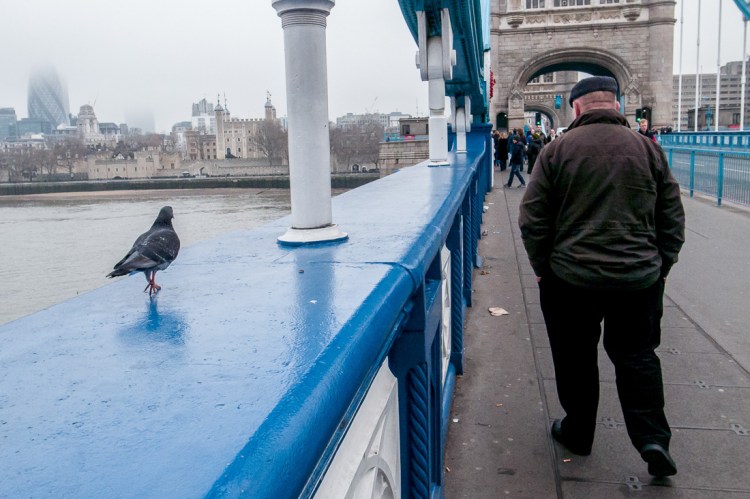
Tower Bridge has long been a magnet for London street photographers. It’s one of those locations where history, tourism, commuters and the everyday theatre of London life collide. This street photograph, taken on 6 January 2013, captures a quiet and subtle moment on the pedestrian walkway of Tower Bridge during the depths of winter.
At first glance, the scene feels simple: a lone man walking away from the camera, shoulders slightly hunched against the cold, while a pigeon stands on the bright blue railing beside him. The Thames moves slowly below, the Tower of London sits in the distance, and the city dissolves into a pale January haze. But look a little closer and a small visual joke begins to emerge.
A Pigeon That Mirrors the Human Walk
The pigeon appears to be almost mimicking the man’s walk. Both are moving in the same direction, both isolated in their own space, and both framed by the strong linear perspective of the bridge. The man strides forward with purpose, while the pigeon takes its short, deliberate steps along the rail, echoing the human movement beside it.
It’s a subtle moment of visual rhythm, one that could easily be missed if you weren’t paying attention. This kind of alignment is at the heart of street photography: unplanned, fleeting, and gone almost as soon as it appears.
Pigeons as a Recurring Theme in Street Photography
Pigeons are a common and recurring motif in street photography, particularly in cities like London. Often dismissed as pests, they’ve become unofficial supporting characters in urban life. From classic street photography to contemporary snapshot work, pigeons are frequently used as compositional elements, sources of humour, or quiet observers of human behaviour.
In this photograph, the pigeon does something more interesting than simply exist in the frame. By mirroring the man’s movement, it becomes part of the narrative, turning an ordinary commute into a small, observational moment with a touch of irony. Exactly the kind of thing I love to find.
Street Photography During The Winter Months
Winter can be a tough season for street photography. In the colder months, people tend to rush from place to place, heads down, focused on warmth rather than interaction. The streets feel more transient, less social. Moments are rarer, unfolding ever quickly and disappear just as fast, leaving little time for anticipation.
That’s what makes images like this especially rewarding. There’s no spectacle or dramatic action, just a brief alignment of movement and mood. Tower Bridge, usually busy and loud, becomes a quiet stage for a small, almost absurd moment.
Why Small Observations Matter in Street Photography
Street photography doesn’t always rely on big gestures or dramatic scenes. Often, it’s about noticing the overlooked: like a pigeon walking in step with a stranger on a cold January morning. These moments may seem insignificant, and are never going to be award-winners, but together they form a truthful, human record of city life.
Sometimes, the most telling stories in London unfold quietly, one step at a time.
The Social History Value of Street Photography
Beyond the humour and observation, street photography plays an important role in recording social history. Images like this don’t just document people and moments, they quietly capture the changing shape of the city itself. In the background of this photograph, the London skyline feels comparatively open, with the Gherkin standing out as a defining marker rather than being hemmed in by glass towers.
Viewed from the perspective of 2026, the scene already feels like a different London. The cluster of high-rise developments that now surround the Gherkin hadn’t yet transformed the skyline in the same way. What was once a distinctive landmark has become part of a dense architectural crowd, reflecting shifts in finance, development, and how the city presents itself to the world.
Street photography preserves these transitions without trying to explain them. It simply shows what was there, on an ordinary day, through an unremarkable moment. The man walking across Tower Bridge, the pigeon pacing beside him, and the skyline behind them form a visual record of London in early 2013, how it looked, how it felt, and how it moved – from my subjective perspective.
That’s the quiet power of street photography. Long after the buildings have changed and the crowds have moved on, the photograph remains, not as nostalgia, but as evidence. A small fragment of time, held still, reminding us that cities are never fixed, only briefly familiar.
Discover more from That Darren Lehane
Subscribe to get the latest posts sent to your email.
 That Darren Lehane